
TIMBER STRUCTURE RESTORATION
You Are Here: TIMBER STRUCTURE RESTORATION
RESTORATION OF TIMBER STRUCTURES
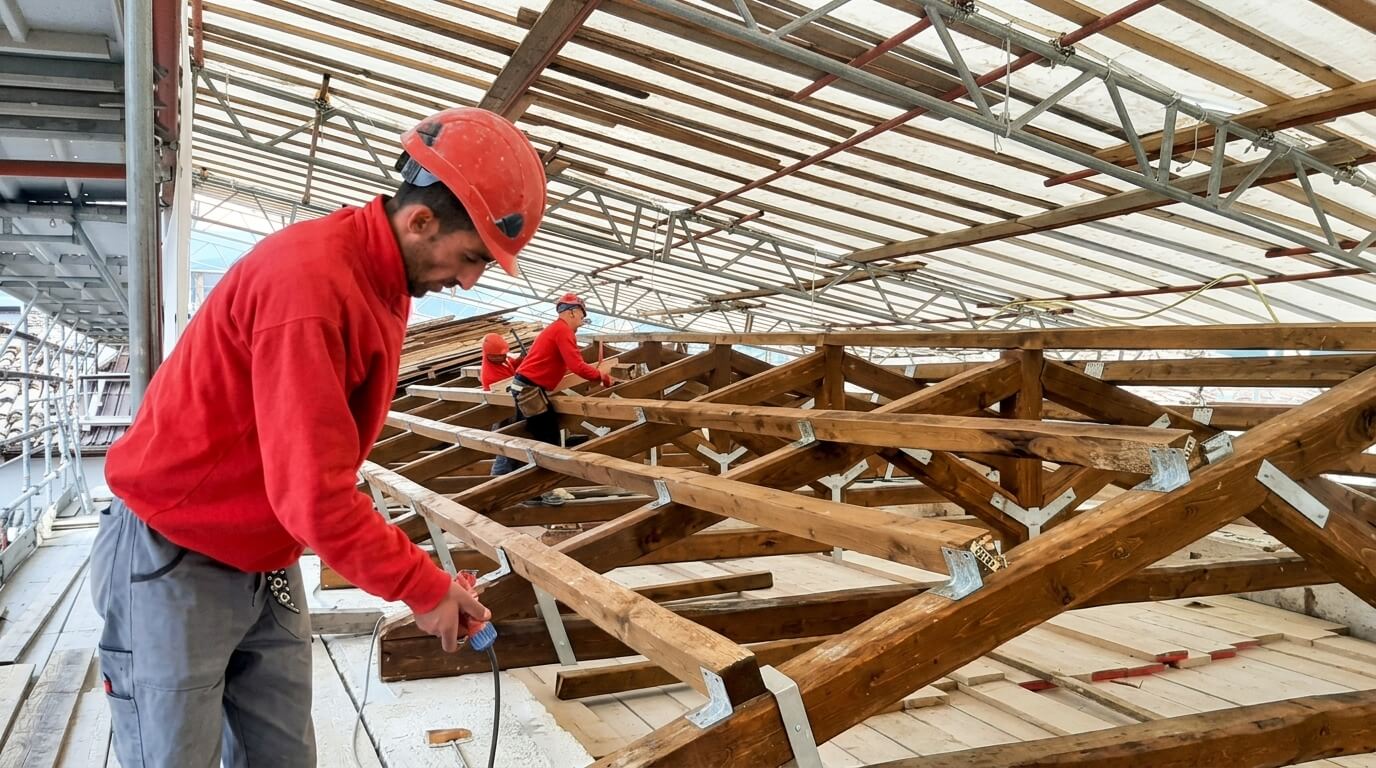
Edilsystem Srl pays particular attention to the restoration of timber elements used in floors and roofs in most older and historic buildings. Careful research has enabled us to identify a range of materials that offer excellent compatibility with timber, outstanding mechanical properties and virtually unlimited durability over time.
This is a specialist field in which only specific expertise makes it possible to identify even the most concealed causes of deterioration and formulate the accurate diagnosis essential for safe and effective restoration.
FUNGICIDAL AND INSECTICIDAL TREATMENT
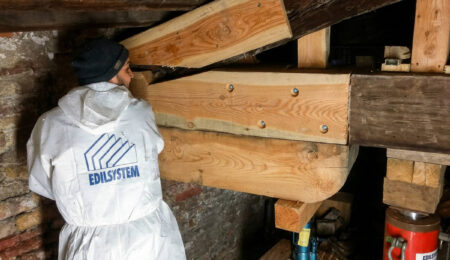
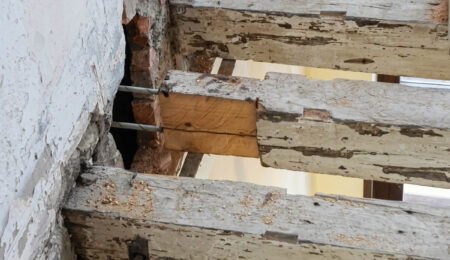
Treatment is carried out by surface impregnation or injection into deteriorated timber elements. Restoration of material continuity – The channels created by insect infestation are filled through the injection of epoxy-based compounds.
Replacement or Reconstruction of Deteriorated Sections
This work involves reconstructing deteriorated sections of primary and secondary timber beams damaged by water infiltration or biological attack. The affected section can be replaced with a new timber element bonded to the existing structure using fiberglass dowels and epoxy compounds, and/or rebuilt by casting epoxy mortars or low-density flowable mortars reinforced with fiberglass bars into permanent formwork.
Strengthening and Consolidation of Timber Structures
Structural strengthening can be carried out by applying carbon-fiber fabrics or pultruded laminates, or by installing fiberglass structural profiles manufactured through pultrusion, using thermosetting resins and heat curing.
Timber floors also perform two fundamental functions in masonry buildings:
- supporting vertical loads (permanent and imposed loads)
- connecting the walls to ensure the building acts as an integrated structural box
In historic buildings, the second function is not always adequately provided because connections between the masonry walls and timber beams are often insufficient. However, this function is essential for seismic safety, as it enables horizontal forces to be distributed among the load-bearing walls in proportion to their respective stiffnesses.
The use of carbon-fiber laminates embedded in a polymer matrix, characterized by mechanical properties superior to those of prestressing steel, is particularly suitable for flexural strengthening.
These laminates are especially effective for strengthening both primary and secondary beams in bending. They also:
- reduce deflections
- increase load-bearing capacity
- improve fatigue resistance
- allow the amount of reinforcement to be tailored to the required performance
- reduce installation times
- provide lightweight strengthening without increasing permanent loads
STRENGTHENING OF CAMORCANNA (REED-LATH AND PLASTER) VAULTS
The intervention involves applying fiberglass fabrics to the extrados (upper surface) of the reed laths to connect and secure the reed framework to the supporting timber battens.
To consolidate the plaster of camorcanna vaults, special fluid acrylic-based mortars are used to impregnate the interface between the plaster and the reed laths.